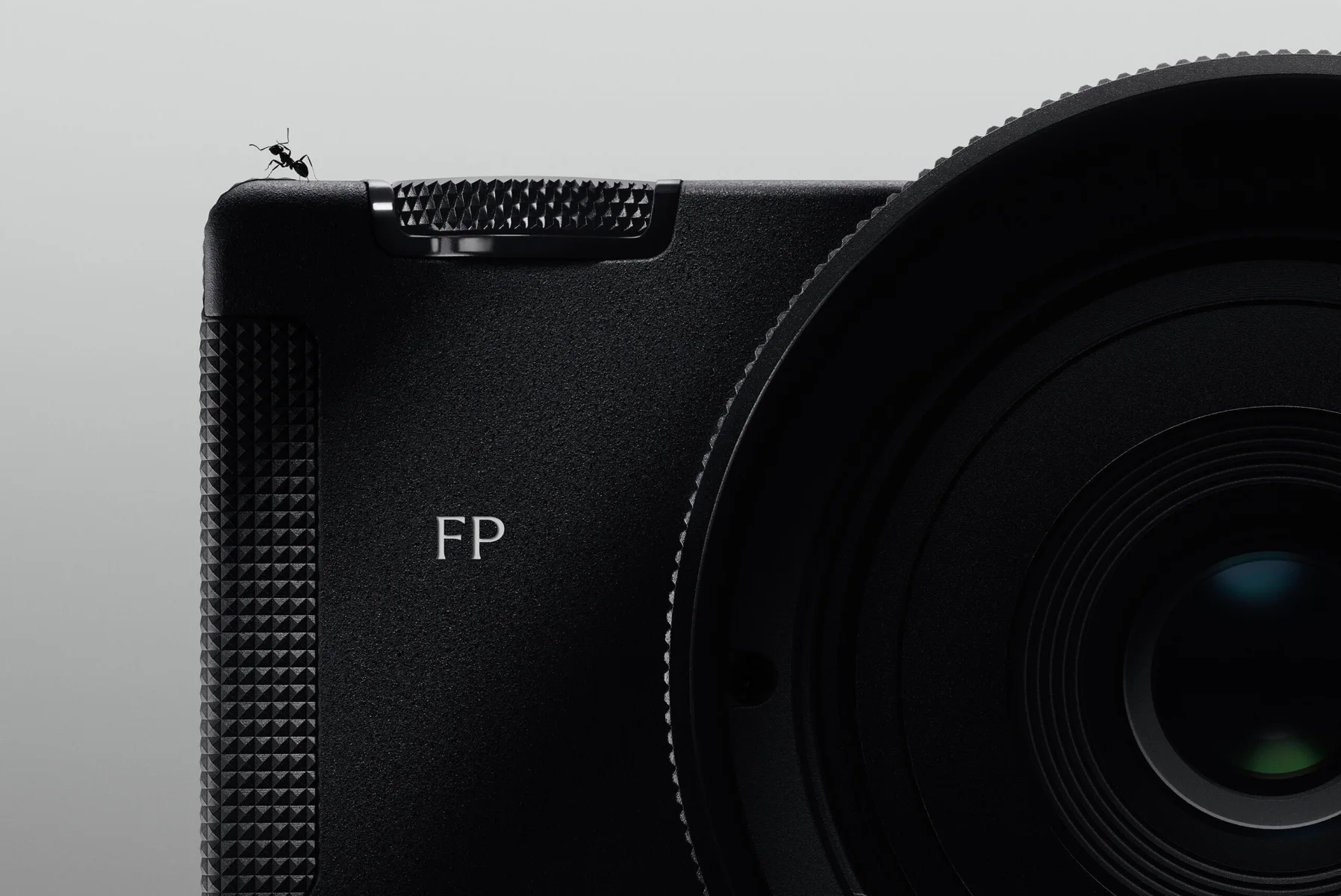
Sigma has introduced the FP2, a second-generation modular full-frame camera built around a 24.5-megapixel partially stacked CMOS sensor. The camera records 6K open-gate material at frame rates up to 59.94fps, with Apple ProRes RAW and ProRes RAW HQ available up to 6K 29.97fps. H.264, H.265 and Leica's L-Log are also listed, alongside 70GB of internal storage, a UHS-II SDXC slot and support for portable SSD recording over USB 3.2.
The cinema workflow extends beyond resolution. Sigma says the sensor's faster readout reduces rolling-shutter distortion, while the camera offers a Director's Viewfinder mode that can simulate framing for systems including ARRI ALEXA 35, Sony VENICE 2 and BURANO. It also provides anamorphic desqueeze monitoring. Optional hardware can add four-channel 96kHz or two-channel 192kHz 32-bit float audio, although Sigma specifies that this requires its HU-21 hot-shoe unit together with compatible Panasonic audio accessories.
For production teams, the technical significance is the combination of full-sensor capture and multiple finishing paths in a body designed to be built out for a particular job. Open-gate recording preserves the 3:2 sensor area for reframing into horizontal or vertical deliverables. Sigma's claimed 14.1 stops of dynamic range applies specifically to 4K full-frame L-Log, however, and is a manufacturer figure rather than an independent measurement.
Several operational questions remain open. Sigma's public material does not map every codec, frame rate and storage medium into one recording table, and electronic image stabilisation is unavailable in 6K. The company also does not publish sustained thermal behaviour, measured rolling-shutter times, timecode and genlock integration details, or tested battery life under high-data-rate recording. Those limits will determine whether the FP2 is best used as a primary compact camera, a specialty angle or a modular cinema body.