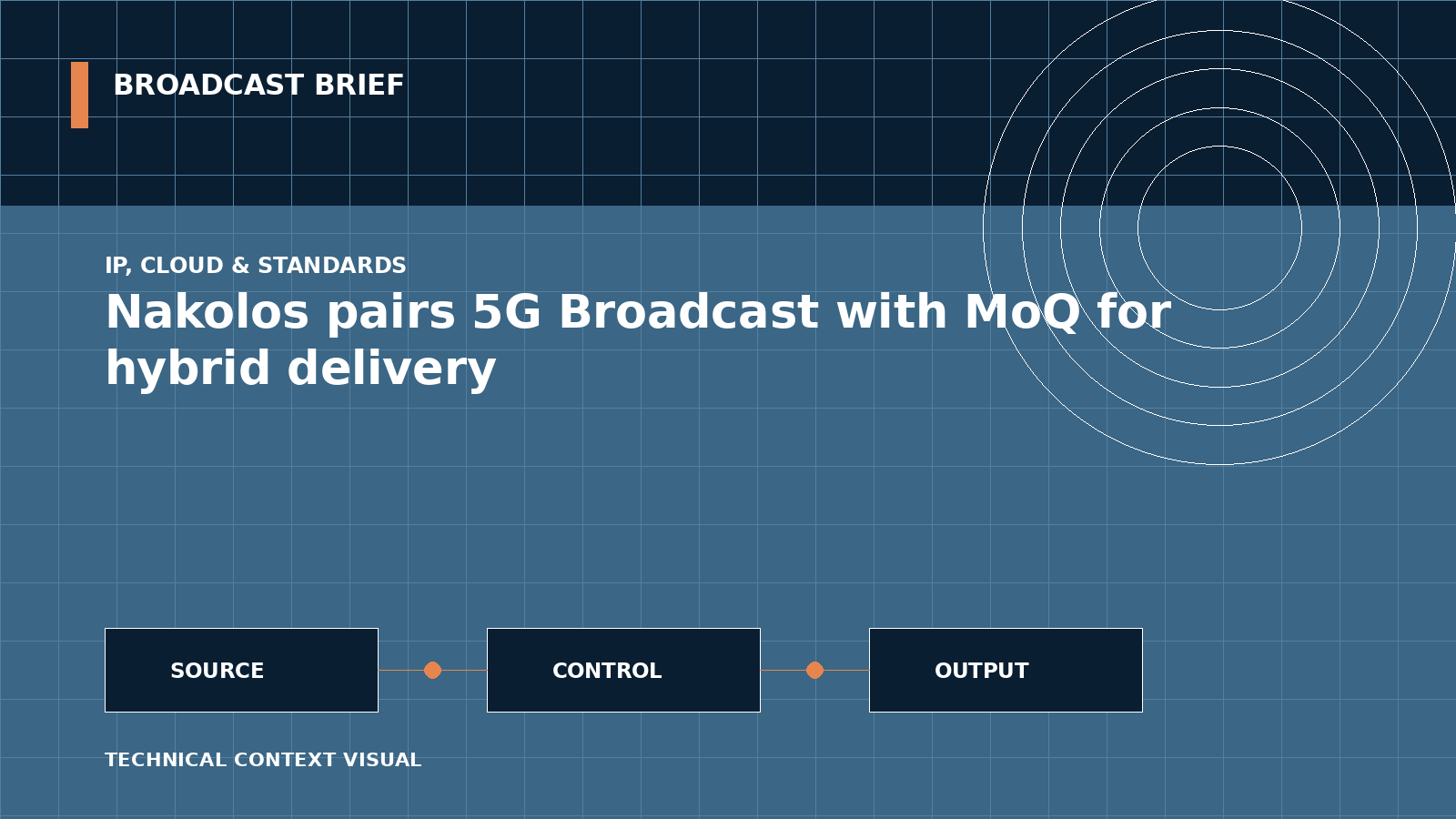
Nakolos has announced a hybrid media-delivery demonstration that combines 5G Broadcast with Media over QUIC. The concept uses a one-to-many broadcast layer for efficient coverage while MoQ provides internet-based delivery for personalised, interactive or fallback services.
The company is targeting sub-second latency and also links the work to emergency-warning capabilities in 3GPP Release 19. These are vendor-stated goals for the demonstrated architecture, not independent performance results across all networks and devices.
Why it matters
Large live audiences are expensive to serve entirely through individual unicast sessions. A hybrid design can place common video on a broadcast bearer and reserve bidirectional IP capacity for features that differ by viewer. MoQ is relevant because it is being developed for low-latency media delivery over modern QUIC transport.
The emergency-warning angle raises a different standard of reliability. Coverage, device wake-up, message authentication, accessibility and operation during network congestion all need to be validated beyond a show-floor demonstration.
What remains open
Nakolos has not published independent latency measurements, a commercial deployment or a complete receiver ecosystem. The relationship between its implementation and evolving MoQ specifications will also need continued interoperability testing.