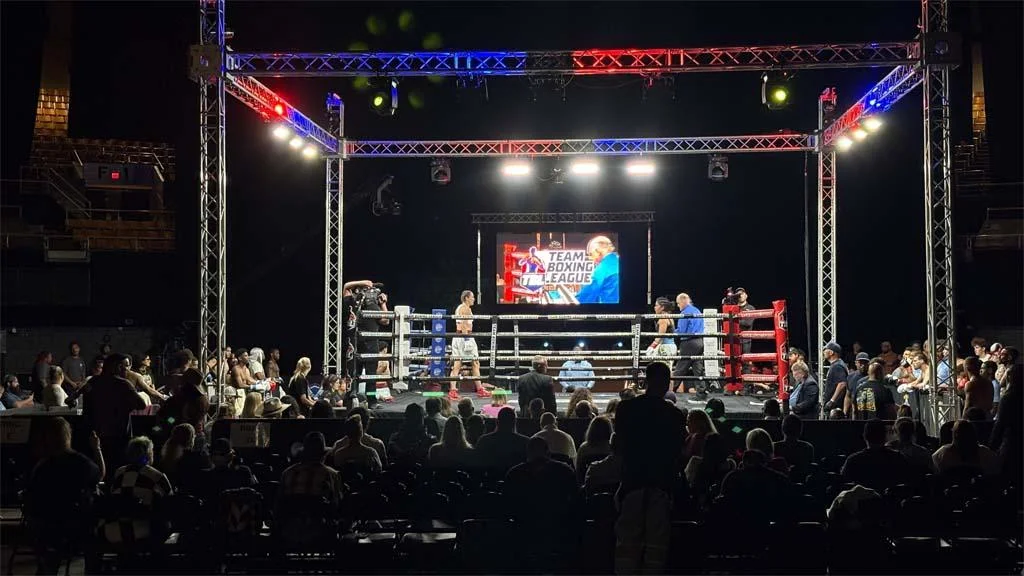
Team Boxing League completed its fourth season with TNDV managing both ends of a broader remote-integration production chain. Three standardized production racks rotated among venues, while TNDV's Sallie HD mobile unit in Irving, Texas served as the central control room. GameTime Productions coordinated camera, audio and other technical crews locally.
Each venue normally supplied six HD camera signals: four operated positions and two fixed cameras covering the team areas. TNDV carried those feeds primarily over SRT on public internet connections, budgeting about 10 Mb/s per video feed. Return programme and confidence multiviewers went back to the venues, with LiveU cellular transmission available to preserve an on-air camera if primary connectivity failed.
Sallie combined the remote feeds with three commentator and studio cameras for a nine-camera production using Grass Valley switching, EVS replay and Calrec audio. TNDV's Nashville operation monitored bandwidth and signal health, managed remote Unity Intercom links and could adjust compression and latency. The finished programme left Irving by SRT, with RTMP conversion available for streaming destinations.
The technical significance is operational scale: the same design supported 56 live events and typically three cities in one weekend without moving a full truck and travelling crew to every venue. The report does not identify codecs, contribution resolution, measured end-to-end latency, packet-loss performance, redundancy switching times or service-level targets. Those figures remain necessary to compare this public-internet REMI model with managed-network alternatives.