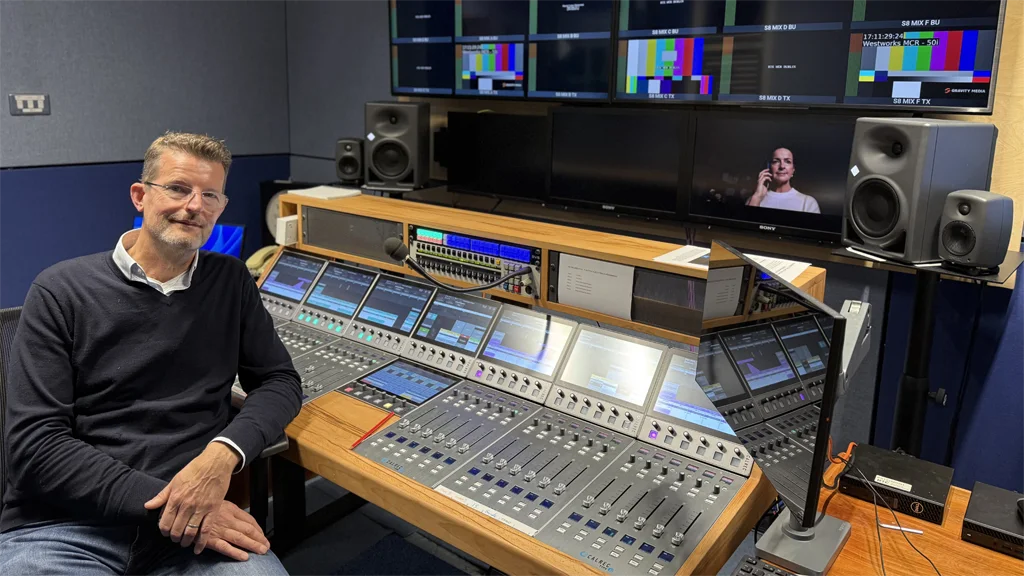
RTÉ used Calrec Type R and its existing SMPTE ST 2110 infrastructure to centralise commentary mixing for the 2026 World Football Championship. Instead of placing a mixer and operator in each of six commentary booths, the broadcaster routed all positions to one multimix area. RTÉ says four operators covered the tournament's 104 matches, with one operator able to handle the six booth feeds from the central position.
The broadcaster first built a development system around a Type R IP Core, physical panels and Calrec Assist in a browser. The production configuration used six six-fader panels, one per commentary position, with a second control layer for auxiliary buses and outputs. Six Large Soft Panel touchscreens supplemented the hardware. The approach adapted a platform already deployed in seven RTÉ radio studios rather than introducing an unfamiliar console family for the event.
Two main and standby Type R cores sat in a rack room, while a passively cooled analogue breakout box remained in the gallery. Mixer, commentary boxes and communications were all connected to RTÉ's ST 2110 house router. The control panels used standard Cat6 links through a switch to reach the cores. RTÉ reports that if the on-air core fails, the standby reconnects to the networked breakout box automatically in about one second.
The architecture shows how an IP-native radio console can become a shared television commentary resource, separating operator surfaces from central processing and reducing duplicated booth hardware. However, the published case study does not specify channel counts, ST 2110 essence profiles, PTP design, NMOS control, network-path redundancy or how the one-second changeover affected programme audio. The staffing and failover figures come from RTÉ and Calrec reporting, and no independent resilience measurements or post-event fault statistics are provided.