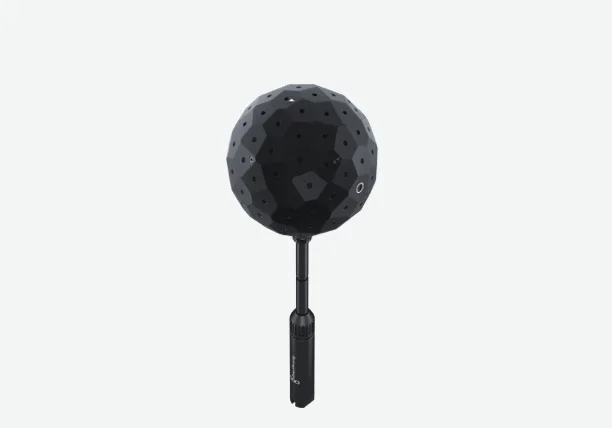
Blackmagic Design has introduced the Blackmagic Ambisonic Microphone, a compact spherical array built around 108 digital MEMS capsules. The device captures a full spatial sound field and uses an internal processor with Apple-licensed array geometry and encoding filters to convert those inputs into seventh-order ambisonics in real time. Blackmagic describes the output as 64 channels of 32-bit audio.
The microphone carries power and class-compliant audio over one USB-C connection, so its published workflows do not require a separate breakout box, driver or encoding application. It can record directly into immersive files on the URSA Cine Immersive camera, connect to a computer for live work in Fairlight Live, or feed an iPhone running the Blackmagic Camera app. A USB-to-SMPTE ST 2110 converter is also planned for broadcast installations.
The technical step is the amount of directional information encoded at the capture device. Higher-order ambisonics provides more spatial resolution than first-order arrays, while internal processing reduces the external hardware needed to produce a usable immersive bed. For live and studio teams, a class-compliant connection may also make the microphone easier to move between camera, workstation and mobile recording roles without rebuilding the signal chain.
Blackmagic says availability is planned for December 2026, but the reviewed announcement does not provide measured self-noise, maximum sound-pressure level, frequency-response data, end-to-end latency or the delivery date and channel mapping of the ST 2110 converter. Production teams will still need to test USB cable length, clocking, monitoring, downstream renderer compatibility and behaviour under sustained high-channel-count recording before treating the single-cable workflow as a commissioned broadcast path.