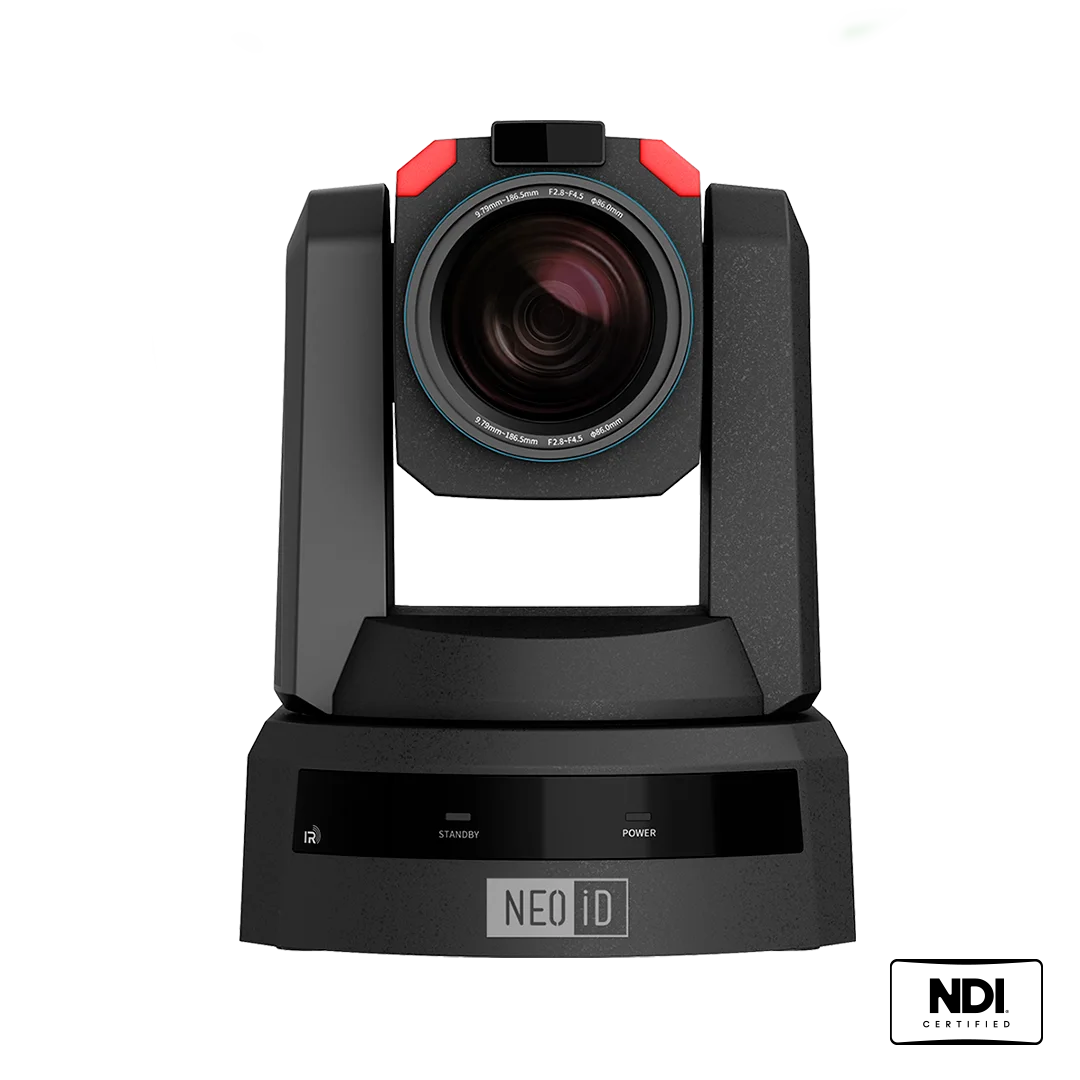
wTVision has completed integration and qualification of NEOiD's PTZ 4K Broadcast camera with wVSet for virtual-set and augmented-reality production. The camera sends pan, tilt, zoom and focus values over FreeD on a dedicated local network. A wTVision tracking plug-in receives that stream while Studio CG controls the production and R³ Engine or Unreal Engine renders the virtual environment.
Each camera-and-lens combination is calibrated during deployment so virtual scenery and AR elements remain aligned with camera movement. wTVision says a fixed installation should not require routine recalibration unless its physical conditions change. Single- and multicamera workflows are supported for live or live-to-tape production, with an independent Full HD or up-to-4K composite for each channel and simultaneous preview before switching.
The integration removes a separate tracking device from compact PTZ studios while keeping camera presets, graphics, backgrounds and AR under one control layer. Studio CG can recall NEOiD presets from the rundown, joining shot selection to the same operational sequence as graphics. NEOiD's official specifications list a 4/3-inch Sony CMOS sensor, 4K capture up to 60 frames per second, 20x optical zoom, 12G-SDI, NDI HX3 and FreeD.
The companies have not published measured tracking accuracy, metadata or video latency, calibration time, maximum camera count, redundancy behaviour, supported Unreal versions or the timing relationship between FreeD data and the selected video output. No named broadcaster deployment or independent on-air test is included. The result should therefore be read as a vendor-qualified integration now available for new wVSet projects, not proof of performance in every studio configuration.