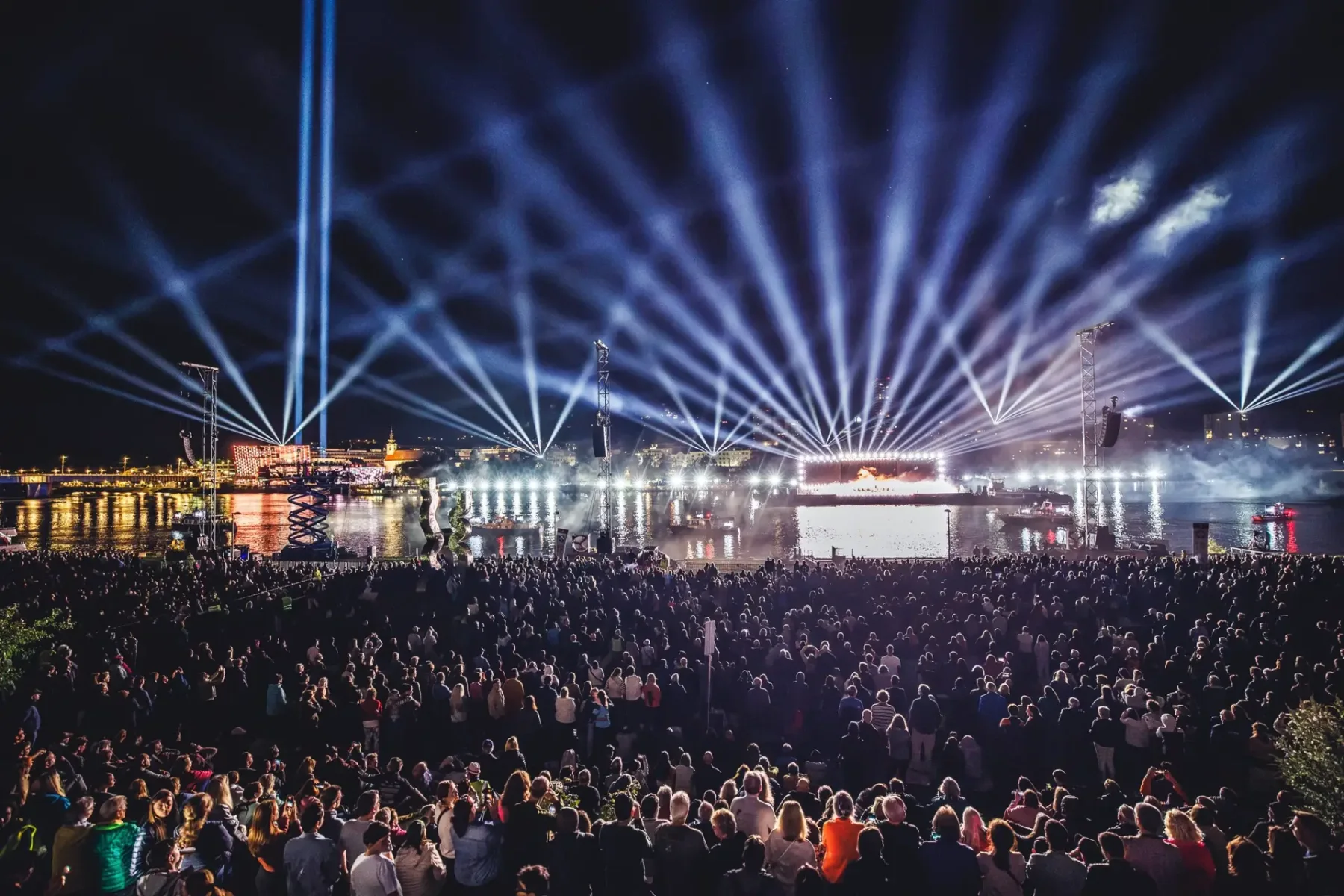
Riedel Communications says one private 5G network carried five different production functions across the Danube during the 2026 Linzer Klangwolke open-air show in Linz. The Easy5G layer delivered video from a media server on the orchestra vessel to LED walls on eight smaller boats. It also transported sACN lighting-control data, timecode and audio from front of house to the orchestra boat, while sending a mixed camera feed back to shore for handoff to the ORF outside-broadcast truck.
The wireless system formed part of Riedel's DIVA+ event backbone. Riedel lists an Easy5G core at front of house, base stations along the river and 14 receivers on boats and onshore. The wider deployment combined about 2.5 kilometres of fibre, 13 network switches, MediorNet, Artist intercom, Bolero, SmartPanels and StageLink. The production itself included an orchestra vessel, eight LED boats, two aerial drones carrying LED screens, roughly 400 lighting fixtures and about 100 loudspeakers.
The technical point is not simply that private 5G replaced a video cable. The same managed radio layer supported media, control and synchronisation traffic in both directions. When a separately connected lighting position suffered a link problem, the team added it to Easy5G with a 5G router and switch. That example shows how a planned contribution path can become shared infrastructure for production departments without creating another independent radio system.
Riedel has disclosed the topology and device counts, but not measured latency, available uplink capacity, spectrum configuration, traffic-priority policy or redundancy behaviour. Those details matter before the design can be compared with dedicated RF video, fibre or separate control links. Even so, the deployment is a useful field example of private 5G carrying mixed live-production traffic rather than one isolated camera feed.