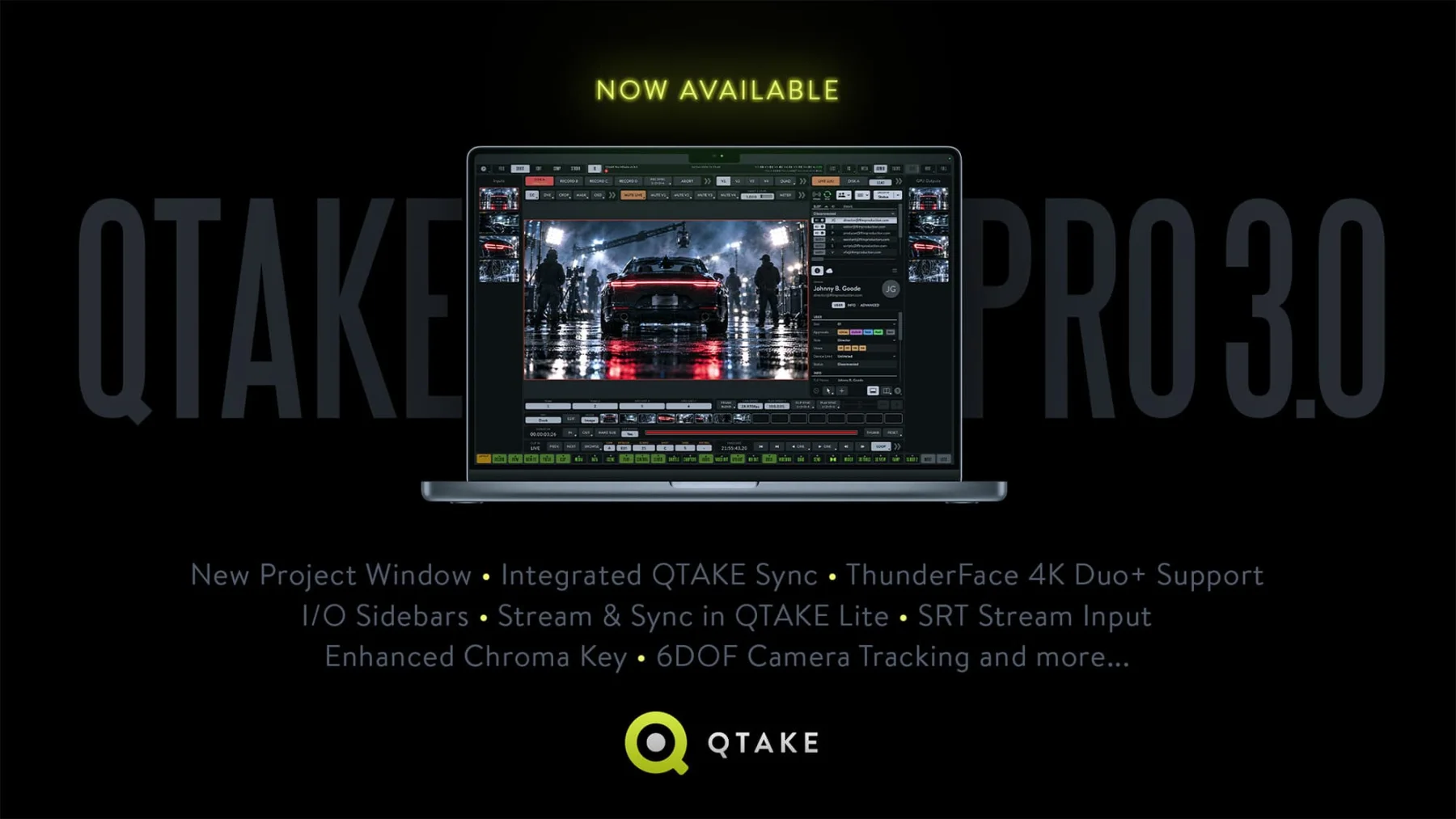
QTAKE has released QTAKE Pro 3.0, rebuilding project setup around a single window for video inputs, outputs, proxy settings and colour bit depth. Operators can mix supported video cards from different vendors within one configuration instead of treating each board family as a separate system. New I/O sidebars keep thumbnail views of live inputs and processed outputs visible while clips or playback occupy the main workspace.
QTAKE Sync is now integrated into the primary application. Authorized crew members can receive recorded clips, metadata and annotations through QTAKE Monitor, with synchronization operating on a local network and reconnecting remote users when connectivity returns. QTAKE Lite also gains local and cloud streaming for up to eight devices plus media upload to QTAKE Cloud.
For live and remote workflows, version 3.0 accepts SRT as a video input alongside SDI, NDI and existing QTAKE sources. Slate Scan and OSD Scan use on-device Apple models to extract clip metadata from physical slates and camera displays, leaving operators able to review and correct the result. A mounted iPhone can supply six-axis position and rotation data for live 3D alignment, while new chroma-key controls refine edges and mattes.
The release is available as a free update for QTAKE Pro users. QTAKE documents the feature set but does not publish a complete compatibility matrix for mixed capture cards, measured SRT latency, supported AI languages or recognition accuracy. It also does not quantify positional precision for the phone-based tracking path. Productions should test their exact cards, formats, network conditions and metadata conventions before relying on the new functions on set.